You can call me David. I’m a third-year Business Management student at Kingston Business School in London, graduating in 2027. Next, I want to do a master’s in healthcare management or general management.
During my internships, I assessed whether companies could repay their debts at a bank, wrote M&A and overseas expansion strategy reports at a health industry group, and built a company’s Douyin (Chinese TikTok) account from scratch.
I want to study healthcare management because of two experiences: visiting hospitals as an intern at Qingdao News Network, and building an operations simulation of a small private clinic for a class assignment. Since then I’ve wanted to understand how an organisation decides who stays, who grows and who keeps contributing over time.
6internships across healthcare, finance, and content & operations
16projects in 5 areas
75Y170.4Y275Y3?Year 2 average, up from Year 1; the degree average follows after graduation
200%follower growth on the Douyin account I ran for an internship
Data & modelling
Python · DCF valuation · Advanced Excel Market research · Competitor analysis · Public opinion monitoring
Student Achievement Award · Academic ExcellenceFaculty of Business and Social Sciences, Kingston University. Presented by the Deputy Dean, February 2026
Business
Marketing
Tech & AI
Design
Fitness
Travel
Football
Golf
Mandarin (native) · English (working language; my degree is taught in English)
−60m
−60 mCV
Deep enough. Time to work.
Six internships, done alongside my degree and grouped into healthcare, finance, and content & operations.
2024.09 – 2027.08London
Kingston University
BSc Business Management · in progress
Year 1 average: 70.4 · Year 2 average: 75. Top modules: Technology in Focus 86.5 · Accounting & Financial Management 78.2 · Business Design Thinking 76.6 · Service Mindset in Business Relationships 76.1.
Core modules include Accounting and Financial Management; Developing Effective Marketing Programmes; Organisations, Culture and Operations; Sustainable and Responsible Management; Technology in Focus; and Business Design Thinking. My coursework projects are in the portfolio below.
Healthcare
2 roles
Closest to what I want to study: strategy at a state-owned group, and marketing at a health management company.
2026.07 – 08Qingdao
Qingdao West Coast Health Industry Development Group
Strategy & Business Development Intern
Diagnosed three core problems in the herbal decoction business: high volume but thin margins, mismatched assets and a single channel. Identified a “shift in the chain of trust”: for food-medicine products, only the doctor-to-patient recommendation still works
Drafted the “dietary prescription” business plan, moving from selling products to doctors to selling services to hospital departments; wrote the Business Development Report myself, through 10 versions to a 28-page final
Shortlisted 16 ingredients from the 106-item food-medicine list and designed 6 SKU concepts; researched industry leader Jiuchu Gaofang and built a six-dimension M&A framework and a five-tier investment spectrum
Researched the UK THR route, EU Novel Food compliance and the UK TCM market, and proposed exporting services and knowledge instead
Since 2025.09Shenzhen
Shenzhen Qiyun Qiyuan Life & Health Management
Marketing Strategy Intern
Turned an early, half-formed idea from management into a ~30-page marketing plan for men’s preventive health and anti-ageing, highly rated by management and partner physicians
Brand positioning: “health evangelist + companion-style health asset manager”; core idea: “Meet Your Future Self × Health Balance Sheet”
Designed a growth loop: educational content → private-session conversion → membership retention → referrals; my brand naming direction was adopted
Finance
2 roles
Corporate banking and an insurance acquisition: reading companies through their numbers.
Built a four-dimension financial analysis framework from a lending perspective (solvency, profitability, operations, growth) and calculated 12 core indicators for several companies, including EBITDA interest coverage
Joined relationship managers on site visits to verify that businesses were real, check equipment and staff, and flag risks such as court notices, brand-new subsidiaries and low insured headcount
Produced a syndicated loan and share pledge briefing deck on my own, wrote corporate credit investigation reports, and studied UBTech’s 2023–2025 annual reports
2023.01 – 02Hong Kong
FTLife Insurance (Chow Tai Fook Group)
Marketing Intern
During Chow Tai Fook Group’s acquisition assessment, joined the project team researching competition in the insurance industry
Helped prepare the value presentation for the acquirer, covering core business lines, competition and industry outlook
Content & operations
2 roles
Media editing and a company account, building content from scratch.
2025.06 – 07Qingdao
Qingdao News Network
Editorial Intern · Science, Education & Health
Laid out and published WeChat articles and reworked headlines and structure; reads rose 200% and likes 250% during my internship
Collected public opinion data and analysed policy information for a training programme for education-system online publicists
Visited and filmed at several Qingdao hospitals, interviewing doctors about their careers and the problems they face
Entered all locations for the “Qingdao Child-Friendly Spots” map, traced a back-end error in the code and got the project launched; made explainer animations in Doratoon
2025.07 – 09
Jinwo International Logistics
Operations · Online Operations & Content Editor
Built the company’s Douyin (Chinese TikTok) account from scratch and set its content strategy and posting schedule; followers grew 200% and views passed 100,000
Turned international logistics know-how into short-video scripts, filmed them myself and edited them in CapCut
Coordinated operations, sales and customer service teams to keep content both accurate and easy to follow
Learned how the international freight business works in depth and built a long-term line of communication with the company, with interest on both sides in working together again
Beyond class: I attended the London Sustainability Conference 2026. Since late 2025 I’ve been teaching myself women’s health, women’s cancer screening and midlife women’s mental health through Stanford Medicine’s open courses. I want to be a manager who understands a bit of medicine.
−110m
−110 mPortfolio
Treasures from the deep
Coursework projects from my degree, grouped by area. Tap a tag to show just one group.
Healthcare
2 projects
The two projects closest to the healthcare management I want to study.
Mapped five swim lanes (booking, consultation, billing, HR, IT) in Signavio, then wrote three linked Python simulations. With one doctor, 96% of patients waited too long, with potential revenue lost from patients leaving of about £1,224 a day; with three, waits fell to 0.2 minutes and the clinic made £4,080 a day. I also found a cash-flow bottleneck (insurance bills paid 29 days late on average) and forecast demand with linear regression (R² = 0.66).
tap to switch
96% of patients wait too long · potential loss per day £1,224
0.2 min average wait · profit per day £4,080
Python
BPMN
Linear regression
US insulin pricing and market failure
BB4207 Global Business Environments · 2025.01
Using Statista data and 2024 industry coverage, I tracked Eli Lilly’s 70% and Sanofi’s 78% price cuts and assessed what the Affordable Care Act and the Inflation Reduction Act actually achieved: most of the benefit went to Medicare patients, while privately insured patients gained little.
Healthcare policy
Market failure
Finance & valuation
2 projects
Valuations and benchmarking built from audited annual reports.
AMD valuationMark: 83
BA5812 Accounting and Financial Management
Collected four years of audited data from a Bloomberg terminal and SEC filings, then built a DCF (WACC 9%) and P/E and EV/EBITDA relative valuations in Excel, benchmarked against NVIDIA, Qualcomm and Broadcom with sensitivity analysis. Conclusion: at $215.34 the shares were well above intrinsic value, so not a buy. My tutor rated the report highly.
DCF
Relative valuation
Bloomberg
Beyond Meat × Oatly financial benchmarking
BA5812 Accounting and Financial Management
Compared the two companies’ audited reports across profitability, solvency, efficiency, liquidity and growth, and recommended to the board how to repair gross margin and stabilise the balance sheet.
Financial ratios
Peer benchmarking
Strategy & organisation
6 projects
Consulting reports, organisational research and industry analysis.
Network Rail IT transformation report
BH5104 Organisations, Culture and Operations
Used Kotter’s eight steps and Lewin’s three-stage model to find why the transformation stalled: no one owned the end-to-end service, and managers lacked the skills to lead change. Proposed three fixes: service owners, manager capability building and automation.
Change management
Consulting report
AI and organisational structure
BH5104 Organisations, Culture and Operations
Using Amazon, BMW, JPMorgan and Google, I found that AI is pushing a hybrid structure: decentralised operations, centralised strategy. The same tools strengthen performance monitoring at Amazon but support workers’ collaborative learning at BMW.
Organisation theory
Case studies
The uneven impact of Brexit and technological change
BB4207 Global Business Environments · 2025.04
Used PESTLE and SWOT with ONS and Bank of England data and annual reports to analyse JLR, Nissan, Tesco and Sainsbury’s: carmakers mainly bore supply-chain and tariff costs, while retailers faced labour shortages on top of currency swings.
Macro analysis
Industry research
Rose Theatre service design
BH4104 Service Mindset in Business Relationships
Designed my own survey of UK audiences: 37% were highly interested, 77% valued an immersive experience and 34% had skipped shows because of ticket prices. Mapped a five-stage customer journey in Canva and analysed it with the service concept, the Servuction model and the experience economy.
Customer journey
User research
Starbucks and the modern workplace
Used a stakeholder map and SWOT to unpack how staff culture shapes a customer service mindset.
SWOT
Stakeholders
Sustain The Pump: a regenerative campus gym
BS5205 Sustainable and Responsible Management · 2026.04
Group project. I led the ecological design and the zero-plastic membership model: rainwater harvesting, kinetic energy recovery and living plant walls, so an energy-hungry space could give resources back. I also wrote an individual impact report.
ESG
Sustainable design
Marketing & brand
2 projects
Integrated marketing and brand positioning.
Mr. Truffle digital marketing campaignGroup mark: 84
BM5212 Developing Effective Marketing Programmes · 2026.03 · group of 4
I led the integrated digital marketing section. Built around “From Forest to Table”, the campaign positions a London truffle brand as both a premium product and an experience. I planned execution across Instagram, TikTok and RedNote, and proposed RedNote to reach the UK Chinese community, a channel no competitor was using.
As an outside consultant, I used PESTLE, STP and client portfolio analysis to assess how AI is changing UK advertising (94% of UK brand marketers already use AI; a £35.5bn market), and proposed differentiated positioning and a UK–US partnership strategy.
PESTLE
STP
Tech & design
4 projects
Prototypes, websites, a 3D model, and the one you’re looking at.
Pawse felt snuffle book in 3DInteractive 3D
AI-assisted 3D modelling · Blender + web 3D
A felt snuffle book for pets: 22 × 22 cm and 3 pages, with treats hidden under cherry pockets and felt flaps. I built it in Blender together with AI, down to the felt, velvet and stitching, then exported it as a web model you can spin around and tap to lift each flap.
Blender
AI collaboration
Three.js
Circa food-sharing app prototype
BS4206 Business Design Thinking · lead writer
Followed the Stanford d.school five-stage process to build a high-fidelity Figma prototype, tested it with 7 target users, and used points, badges and community ratings to lift engagement. When a teammate left mid-project, I reassigned the work and we delivered on time.
Design thinking
Figma
User testing
Champions League fan website
BB4205
Built a multi-page responsive website on my own, separating structure and style with XHTML/CSS, with a sustainable design plan built in.
XHTML/CSS
Responsive
Pangchuan and this websiteYou’re looking at it
Started from a few selfies and tried several art styles with ChatGPT before settling on this shark; then built it with Claude into a website that watches you and dives with you.
Character design
AI collaboration
−160m
−160 mDaily life
A day in the life of a shark
Tap one and he’ll jump.
Up, eyes not open yet
Coffee first
Running to class
Writing a report
Burger for lunch
Reading in the library
An idea strikes
Gym
Cat therapy
One quick game
Still chasing a deadline
Even sharks need sleep
−200m
−200 mSeabed
Reached the bottom. A bit sleepy.
Want to talk about internships or projects, or just see the shark? Get in touch.
Qingdao West Coast Health Industry Development Group
Strategy & Business Development Intern
A state-owned TCM and health industry group. I reported to both group management and project managers and worked on the group’s shift from traditional decoction services to higher-margin businesses.
What I did
Business diagnosis and model: Found three core problems in the decoction business: high volume but thin margins, mismatched assets and a single channel. Identified a “shift in the chain of trust”: the old model of selling food-medicine products through influencers to consumers no longer works, and the only channel that still does is a doctor’s recommendation to a patient. On that basis I drafted the “dietary prescription” plan: be the doctor’s back office, not their salesperson. The partnership moves from selling products to doctors to selling services to departments, with four mechanisms that reduce doctors’ personal risk.
Strategy report: Led the Business Development Report myself, through 10 versions to a 28-page final, with a mind map and a one-page strategy brief.
Product selection and compliance: Went through China’s food-medicine list (106 items) and cross-checked it against the EU Novel Food catalogue to flag export candidates. Shortlisted 16 core ingredients and designed 6 SKU concepts across soup packs, ready-to-eat pastes and tea bags, with a three-layer competitor analysis.
Competitor and M&A research: Studied public information on industry leader Jiuchu Gaofang and concluded the opportunity was not head-on competition: Jiuchu runs a B2B consumer goods business, while ours lies in closed-loop medical services inside hospitals. Built a five-tier investment spectrum (exclusive OEM → minority stake → strategic stake → joint control → full acquisition) and a six-dimension framework for assessing targets.
Inventory management: Traced the conflict between sales and finance KPIs to its root and proposed a three-layer framework (ABC classification and reorder formulas for stable products, dynamic safety factors for volatile ones, fast response for bestsellers), a four-colour expiry alert system and a matching Excel tool.
Store interview toolkit: A preparation checklist, a 15-question interview guide in 4 sections, a field notes template, a 6-dimension scoring system and a five-level partnership rating.
Strategic partnership meeting: Joined the group’s meeting with an A-share listed pharmaceutical company and saw how payment terms, logistics and bargaining power work in pharmaceutical distribution.
Overseas research: Researched the UK THR registration route, EU Novel Food compliance and the UK TCM market, and proposed exporting services and knowledge instead of traditional THR registration.
What I took away
This internship was the first time I really thought at group level. Strategy isn’t an abstract framework. It’s a series of judgements, weighed again and again, with incomplete information, unequal interests and real limits on what can be done.
What struck me most was spotting the shift in the chain of trust. Food-medicine products weren’t failing in consumer retail because of the category, but because of trust: once wellness influencers lost their authority, only doctors still worked as a channel. That insight changed the direction of the whole plan, and showed me that business model innovation starts with finding which relationships of trust are still intact.
I also picked up a habit that has stayed with me: data discipline. The plan separates publicly verifiable information, reasoned estimates and things that weren’t estimated at all, and never rests a conclusion on an unsupported number.
In real strategy work, a wrong number is more dangerous than no number.
Since 2025.09Shenzhen
Shenzhen Qiyun Qiyuan Life & Health Management
Marketing Strategy Intern
A functional medicine health management company. My starting point was a broad, half-formed business idea from management; my job was to turn it into a complete marketing strategy that could actually be carried out.
What I did
Bringing the material together: Read through expert lectures and product materials and distilled one business logic: functional medicine + preventive health + ongoing support.
Strategy and positioning: Positioned the brand as a “health evangelist + companion-style health asset manager”, and shifted the model from selling products and cures to selling understanding plus long-term support through membership.
Core idea: “Meet Your Future Self × Health Balance Sheet”. Built on an AI health digital twin, it turns abstract “health capital” into something people can see, track and renew.
Growth loop: educational content → private-session conversion → membership retention → referrals. Early spending builds brand and trust; later, those assets bring in new customers by themselves.
Market insight: Used public data to test assumptions such as “anti-ageing spending is getting younger”, built three customer personas with priorities, and produced a market data report with graded evidence.
Content and messaging: Translated specialist medical content into plain language and built an educational content system.
Brand naming: Proposed the “Yuan + Qi” naming direction, which management adopted.
Deliverables: A ~30-page marketing plan, plus customer personas, market data and a naming proposal.
What I took away
Management (a former general manager of a listed company) and partner physicians rated the plan highly and called it “a surprisingly good plan”. They singled out three things: it grasped that the real business is helping people understand their health first, it developed the core idea independently and grounded it, and it built a growth loop that compounds.
This was my first full experience of building a business plan from zero to one. What stayed with me most was translating across disciplines: if ordinary consumers can’t understand functional medicine, even a great product won’t turn into business value. Much innovation in healthcare isn’t about technology at all, but about new ways of communicating and building trust.
Turning a vague business instinct into a clear chain of actions.
Financial statements: Organised and checked several companies’ financial statements in Excel and built a standard entry and validation template.
Analysis framework: Built a four-dimension framework from a lending perspective (solvency, profitability, operations, growth) and calculated 12 core indicators for several companies, including EBITDA interest coverage, total interest-bearing debt and capital accumulation rate.
Industry research: Read UBTech’s 2023–2025 annual reports, broke down its humanoid robotics and AI education businesses, looked at how its MES, WMS and CTS systems support delivery at scale, and wrote an independent assessment.
Site visits: Took part in background checks and on-site visits, verifying that the business was real and checking signage, equipment, fixed assets and staff; flagged risk signals and helped photograph, record and negotiate.
Briefing deck: Produced a syndicated loan and share pledge briefing on my own, covering definitions, the lead bank’s process, key points in share pledge approval, head office priorities and sales scripts, a log of completed deals and market risk appetite.
Credit investigation: Wrote corporate credit investigation reports (including consolidated statements), tracking companies’ financial position and technical standing.
Compliance and innovation: Followed regulatory penalties and the full process of non-performing loan disposal, and the underwriting model of China’s first dual-labelled “Two New + Sci-Tech” bond.
What I took away
I used to think a bank was where you open an account, deposit money and invest. This internship showed me how complex corporate banking is. The same company looks different to each audience: investors look at growth, management at efficiency, and the bank at whether it can repay on time, where its risk exposure lies and whether the collateral is enough.
The visit I remember best was to a construction company in Nanshan, Shenzhen. The client worked out of a villa, and the boss and a friend took turns making demands. My two colleagues were neither soft nor hard: they explained the bank’s licences and capabilities professionally. Even with several court notices, mostly brand-new subsidiaries and a low insured headcount, we agreed the client would book an account opening first, and we would look at cash flow and collateral next.
Lending isn’t a yes-or-no question. It’s a process of weighing things up.
2023.01 – 02Hong Kong
FTLife Insurance (Chow Tai Fook Group)
Marketing Intern
My internship came during Chow Tai Fook Group’s strategic acquisition assessment of FTLife, and our audience was the acquirer’s senior management.
What I did
Joined the project team researching competitiveness in the insurance industry.
Helped prepare the business value presentation for the acquirer, covering FTLife’s core business lines, competitive landscape and industry outlook.
What I took away
This was my first look at strategic analysis in a real acquisition, and it showed me that a company’s value means different things in different settings.
In capital markets, value is a valuation multiple; in a strategic acquisition, it’s synergies and risk exposure.
2025.06 – 07Qingdao
Qingdao News Network
Editorial Intern · Science, Education & Health
What I did
Content operations: Laid out and published articles on the WeChat account and reworked headlines and structure; reads rose 200% and likes 250% during my internship.
Map project: Entered all the information for the “Qingdao Child-Friendly Spots” map myself; when the back end kept throwing errors, I traced the problem in the code, pushed for a fix and got the project fully launched.
Hospital visits: Visited and filmed at several Qingdao hospitals and interviewed doctors about their careers and difficulties, seeing real management problems first-hand, such as broken staff incentives and poorly managed patient flow.
Public opinion and policy: Collected public opinion data and analysed policy information for a training programme for education-system online publicists.
Explainer animation: Made an educational promotional animation in Doratoon on my own.
What I took away
The rise in reads and likes let me test a content strategy in a real media setting: understanding what the audience needs is the core of content quality.
The hospital visits had a deeper effect. As the person recording, I saw how hospitals and the media work together, how doctors move to small suburban hospitals to qualify for promotion, and the gap between the image publicity creates and the work on the front line. After one interview, a doctor let out a long sigh and said he could finally go back to his old hospital. Standing beside him, I just felt how tired he was: not tired from being busy, but from being pushed along by the rules of a system for a long time.
I also noticed how hard it has become to keep doctors in the profession. The best platforms and most awards sit within the public system, so doctors who leave public hospitals find it hard to keep growing or be recognised; those who stay face modest base pay and deductions after disputes with patients, which is also where opaque income creeps in. Some hospitals took on debt as they expanded and have even fallen behind on wages. When doctors who took years to train end up changing careers, society loses a great deal. Sanming’s reform, which cut doctors’ pay loose from drug and test revenue and moved them to annual salaries, and Hong Kong’s pairing of good pay with independent anti-corruption oversight, made me want to study how an organisation should design pay and incentives to keep its people.
Management problems in healthcare are often not one person’s failure, but the state that rules leave ordinary people in over time.
2025.07 – 09
Jinwo International Logistics
Operations · Online Operations & Content Editor
What I did
Account launch: Built and ran the company’s Douyin (Chinese TikTok) account from scratch and set its content strategy and posting schedule; followers grew 200% and total views and impressions passed 100,000.
Turning expertise into content: Turned international logistics know-how into short videos people want to share, writing the scripts and editing in CapCut myself.
Working across teams: Coordinated operations, sales and customer service to balance accuracy with readability.
Industry and partnership: Got to know how the international freight business works in depth, and built a long-term line of communication with the company, with both sides interested in working together again.
What I took away
Going from zero to 100,000 views was my first complete experience of turning specialist knowledge into value for users, and it taught me how content operations really work.
What I learned about freight, and this long-term line to a logistics partner, can come with me to future employers: when a company needs to ship across borders or set up logistics, I can help it find a reliable partner faster and avoid detours.
Deep expertise and plain language can make each other stronger.
BM5212 Developing Effective Marketing Programmes2026.03 · group of 4 · I led Section 4
Mr. Truffle digital marketing campaign
Group mark: 84/100
A digital marketing plan for Mr. Truffle, a London truffle brand that sells premium truffle products and experiences such as truffle-hunting trips to Italy. I led Section 4 of the group report: the integrated digital marketing campaign.
3 + 4Weekly posts on Instagram / TikTok
5 stagesCustomer journey, from attract to advocate
0Competitors active on RedNote
How I did it
Big idea: “From Forest to Table”, linking product and experience in one story.
Multi-platform plan: Instagram as the main platform with 3 posts a week (Reels on Monday, Stories on Wednesday, carousels on Friday); TikTok with 4 a week (product close-ups and ASMR, an Italy experience teaser, chef collaborations); Pinterest for recipe boards and LinkedIn for B2B clients such as Michelin restaurants and corporate gifting.
RedNote (Xiaohongshu): high purchase intent, trusted peer recommendations, reach into the UK Chinese community, and no competitor presence. I proposed this channel, drawing on knowing both consumer cultures.
Two-tier influencer plan: 3 UK micro-influencers (10k–100k followers), each posting 1 Reel and 2 Stories, with gifted products and vouchers, plus 1 macro influencer for credibility.
Owned channels: a “Join the Mr. Truffle community” sign-up on every page, triggering a 3-email welcome sequence, with separate messages for product buyers and experience bookers.
Two engagement mechanics
Experiential seeding: a quarterly draw sends an email subscriber on a truffle trip; winners share on social media, lowering the psychological barrier to high-priced experiences.
#MyTruffleMoment UGC campaign: customers share their truffle dishes, unboxings and dining moments; each month one wins a gift box or an Italy trip voucher.
Customer journey and KPIs
A five-stage journey: Attract (Instagram, TikTok) → Engage (influencers, blog) → Convert (website, email) → Experience (truffle hunts, events) → Advocate (UGC, seeding). Each stage feeds the next, following the RACE framework.
KPIs include email sign-ups, engagement rate, experience booking growth and website conversion. These are campaign targets, not actual results.
BB5114 Technology in Focus2026.04 · Individual report
Private clinic operations simulation (Python)
Mark: 86.5
The assignment was to build an operations simulation for a small business; one of the options was a small private clinic, and I chose it. Small clinics are short-staffed and get no public subsidy, so a little inefficiency in scheduling or billing turns straight into lost revenue and lower staff morale. The question: can process modelling and data simulation reveal these problems in advance?
3Ideal number of doctors at peak times
0.2 minAverage wait with 3 doctors
29 daysWait to collect 80% of revenue
How I did it
Mapped the clinic’s five core functions in Signavio using BPMN 2.0: patient management, medical services, billing, HR, and IT and health information. Rather than a separate lane, IT is modelled as data stores (electronic records and the booking system) supporting every other function, which is closer to how a small clinic really works.
Wrote three linked Python scripts: a booking and scheduling simulation, a billing and collections simulation, and a decision dashboard combining the two. The scripts exchange data as JSON and map one-to-one onto the process model.
Booking simulation: 50 patients a day, one every 9 minutes at peak, consultations averaging 20 minutes (standard deviation 5), comparing one, two and three doctors.
Ran a linear regression on 12 weeks of history (R² = 0.66) to forecast patient numbers for the next 4 weeks and recommend staffing automatically.
What I found
Doctor numbers are a threshold, not a straight line. With one doctor the average wait was 254 minutes and 96% of patients waited over 20 minutes, with potential revenue lost from patients leaving of about £1,224 a day. With two doctors the wait was 26 minutes and 66% still waited too long. Only three removed the bottleneck, cutting waits to 0.2 minutes and earning £4,080 a day. Recommendation: three doctors at peak (9:00–13:00) and two off-peak.
Billing hid a cash-flow bottleneck. Under the current process, 80% of revenue took 29 days to arrive, in effect giving insurers almost a month of unsecured credit. Automatic insurance chasers on day 7 and day 14 would cut settlement from 24.3 days to 7, and a 20% deposit from self-paying patients would cut bad debt from 10% to under 2%. Together these would improve net income over 4 weeks by £6,042.
Forecasting gives early warning. By week 16, weekly patients would reach 279, needing 7 doctors, a signal the current reactive scheduling would never give.
Three ethical issues: patient data privacy (UK GDPR), algorithmic advice not replacing human judgement, and deposits possibly shutting out low-income patients, so I suggested waivers or instalments.
What I learned
This was the first time I used data tools to turn problems I had thought of as fate into things that can be designed and adjusted. But I also came to see that process optimisation only solves part of the problem: some doctors leave not because the system is inefficient, but because for years they can’t see a real link between their ability and their reward.
Many things I thought couldn’t change can at least be seen more clearly.
BA5812 Accounting and Financial Management2026.04 · Individual report
AMD valuation
Mark: 83
AMD is one of the most debated valuations of the AI chip boom. The report asks one question: is a $215.34 share price expensive?
$192.35DCF intrinsic value per share
$107–122Relative valuation range from peers
$215.34Market price at the time
How I did it
Collected four years of audited data (FY2022–FY2025) from a Bloomberg terminal and AMD’s SEC filings, and analysed revenue, gross margin, free cash flow and key ratios.
DCF: forecast free cash flow for FY2026–FY2029 at a 9% WACC. Instead of AMD’s own historical growth of 13.6%, I used the 4% industry average to keep the forecast conservative.
Relative valuation: estimated a fair price from the P/E and EV/EBITDA multiples of NVIDIA, Qualcomm and Broadcom, with sensitivity analysis.
What I found
The fundamentals are improving: revenue rose from $23.6bn to $34.6bn, gross margin from 45.7% to 49.5%, and FY2025 free cash flow reached $6.7bn, driven by data centres and AI accelerators.
All three methods say the shares are overvalued, but by very different amounts: the DCF gap is only about 10.7%, while relative valuation puts it at 43–50%. That gap itself shows the market is paying a premium for AI growth continuing.
Conclusion: existing investors can hold, but new investors should wait for a better price. The biggest downside risks are slower AI infrastructure spending, NVIDIA’s ecosystem growing stronger, and tighter US export controls on China.
Note
My tutor rated the report highly.
BA5812 Accounting and Financial ManagementIndividual report
Beyond Meat × Oatly financial benchmarking
Written as if for Beyond Meat’s board: a ratio analysis of the company’s performance and financial position in 2022–2023, compared with its peer Oatly.
8.0Current ratio, 2022
122% → 182%Gearing
NegativeGross margin and ROCE
How I did it
Calculated ratios across five areas (profitability, efficiency, liquidity, capital structure and returns), showing each formula and calculation, then compared them with Oatly.
What I found
A good-looking ratio isn’t always a safe one. The current ratio was as high as 8.0, but current assets were mostly inventory rather than cash, and cash fell further in 2023, so the ratio hid real liquidity risk.
The capital structure kept getting worse. Gearing rose from 122% to 182%; above 100% it loses its usual meaning and is a warning in itself. Accumulated losses pushed equity negative, so ROCE also stopped being meaningful.
The problems are mostly internal. Facing the same inflation and demand, Oatly kept a positive gross margin, which suggests Beyond Meat’s trouble comes mainly from high production costs, low plant utilisation and slow inventory turnover.
Recommendations: the board should track the measures that drive gross margin directly, such as cost per pound and plant utilisation; with negative equity, financing strategy has to be tied to operating decisions.
What I learned
Writing for a board pushed me from calculating ratios to giving decisions people can act on. I also learned to be wary of ratios distorted by inventory or negative equity.
BH5104 Organisations, Culture and OperationsIndividual consulting report · real case
Network Rail IT transformation report
Network Rail’s IT department supports about 35,000 staff across Britain. Since 2019 its performance has been questioned; it wants to be the business’s “partner of choice”, but several rounds of change achieved little. As an outside consultant, I analysed why and made recommendations.
How I did it
Used Kotter’s eight-step model and Lewin’s three-stage model (unfreeze, change, refreeze), together with staff feedback and service data from the case, to diagnose why the change didn’t stick.
Root causes
A structure organised by technical speciality split responsibility for each service across stages, so no one owned the end-to-end result and teams fell into firefighting.
Staff were unhappy with their line managers and lacked development support; managers lacked the skills to lead teams through long-term change.
Ownership of the change wasn’t reinforced at team level, so staff kept disengaging.
Recommendations
Appoint service owners accountable for customer outcomes, and cut hand-offs between stages.
Invest in line managers’ people management, coaching and change leadership, and make engagement and team capability part of their role.
Use automation and AI for frequent, repetitive frontline support, such as ticket triage, knowledge search and self-service, freeing people for higher-value work.
What I learned
The real case showed me that IT performance is never an isolated internal function: it affects service reliability and internal trust in a safety-critical industry. I also learned to write a consulting report with a clear purpose, focused analysis and specific, workable recommendations.
BH5104 Organisations, Culture and OperationsIndividual essay
AI and organisational structure
Once AI is part of everyday work, how do organisational culture and structure change? And how do culture and structure shape how AI gets used?
How I did it
Used Amazon, BMW, JPMorgan and Google as cases, drawing on Schein’s theory of organisational culture, Mintzberg’s work on structure, and research from McKinsey and others.
What I found
Core argument: AI isn’t just an automation tool. It amplifies an organisation’s existing logic and creates new tensions around autonomy, fairness, transparency and the legitimacy of human judgement.
Structure: AI is pushing a hybrid of decentralised operations and centralised strategy. AI support gives the front line more room to decide, while strategy and algorithm governance move further towards headquarters.
Culture: the same tools can point in opposite directions. At Amazon, daily conversation revolves around performance metrics and algorithmic insights: more transparent, but with less informal knowledge sharing. BMW uses AI to support workers’ collaborative learning, continuing its people-centred manufacturing tradition.
Technology never decides where an organisation goes on its own; what matters is the organisation’s existing culture and power structure.
BB4207 Global Business Environments2025.04 · Individual case portfolio
The uneven impact of Brexit and technological change
Brexit and the rapid rise of automation and AI hit the UK economy at the same time. This assignment compares their effects on car manufacturing and food retail.
How I did it
Used PESTLE and SWOT to analyse Jaguar Land Rover, Nissan, Tesco and Sainsbury’s, drawing on Office for National Statistics data, Bank of England exchange rates and company annual reports.
What I found
The impact is uneven. Carmakers mainly bear cross-border supply chain and tariff costs; retailers face labour shortages on top of cost pressure from currency swings.
The best performers combined innovation with strategic localisation. Digital capability, investment strength and alignment with environmental and trade policy were the key success factors.
Long-term resilience depends on inclusive policy, investment in digital skills and more support for small businesses.
What I learned
It got me interested in how policy risk travels through different routes to shape the international strategies of different industries.
BH4104 Service Mindset in Business RelationshipsIndividual blog report
Rose Theatre service design
Founded in 2008, the Rose Theatre in Kingston is one of the largest producing theatres in south-west London. The question: how can a theatre win audiences through great service?
37%Highly interested in theatre
77%Value an immersive experience
34%Skipped a show because of price
How I did it
Designed and ran my own survey to collect real data from UK audiences.
Mapped a five-stage customer journey in Canva for a typical audience member: a Chinese student at Kingston going to a show with her boyfriend.
Analysed it using Johnston & Clark’s service concept, the Servuction model and Pine & Gilmore’s experience economy.
Findings and recommendations
Audience interest isn’t low; the real barriers are price and experience.
Use survey feedback to improve programming; add personalised digital recommendations, a simpler booking process and targeted content.
Introduce family and student discounts to win back the third of audiences lost to ticket prices.
BS4206 Business Design Thinking2025.03 · team of 3 · lead writer
Circa food-sharing app prototype
Existing food-sharing platforms (Too Good To Go, OLIO) don’t serve low-income people, older people, people less used to digital products or non-native English speakers well; categories are unclear and there is little to build trust. Circa aims to fix this while cutting food waste.
How we did it
Followed the Stanford d.school five stages: empathise, define, ideate, prototype, test. User interviews and empathy maps identified four core user groups.
Built low- to high-fidelity prototypes in Figma, tested them with 7 target users (international students, supermarket staff and people on low incomes) and iterated.
When a teammate left mid-project, I reassigned the tasks so we still delivered on time.
Design highlights
Trust: contact verification, user levels and community ratings.
Incentives: badges first, then a points system: each successful share earns points that can be redeemed for supermarket discounts.
Ease of use: a short quiz shows new users what can and can’t be shared; the interface follows the “don’t make me think” principle, with colour-coded icons for each function.
Personal project · AI-assisted 3D modellingModelled in Blender · rendered in Cycles · interactive in Three.js
Pawse felt snuffle book in 3D
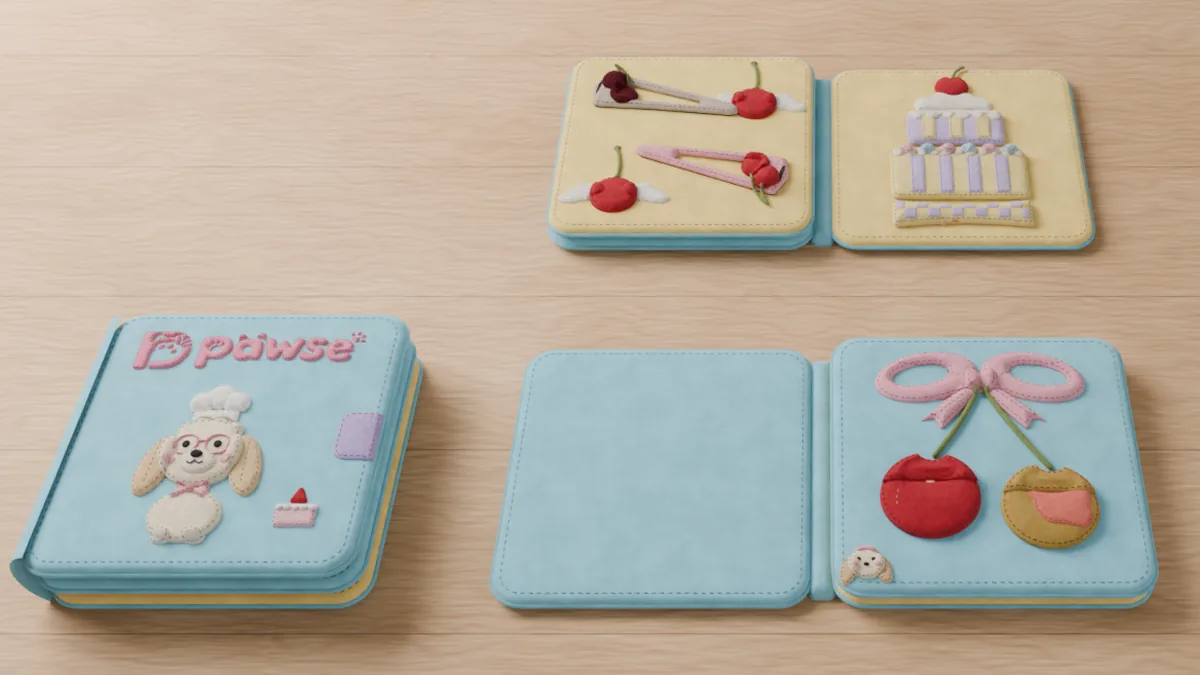
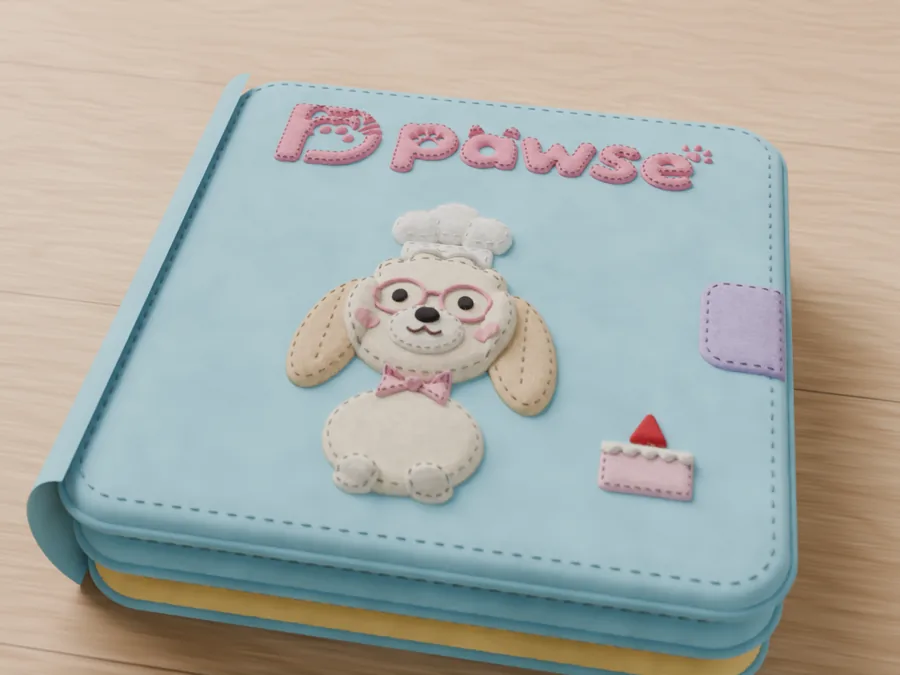
A snuffle book is a puzzle toy for pets: treats hide under flaps and in pockets, and pets sniff them out. This model recreates a 22 × 22 cm, 3-page felt snuffle book, from the dog on the cover and the cherry pockets down to every ring of stitching along the edges.
338separate parts, so every felt flap lifts on its own
600kvertices
98materials: felt, velvet and thread
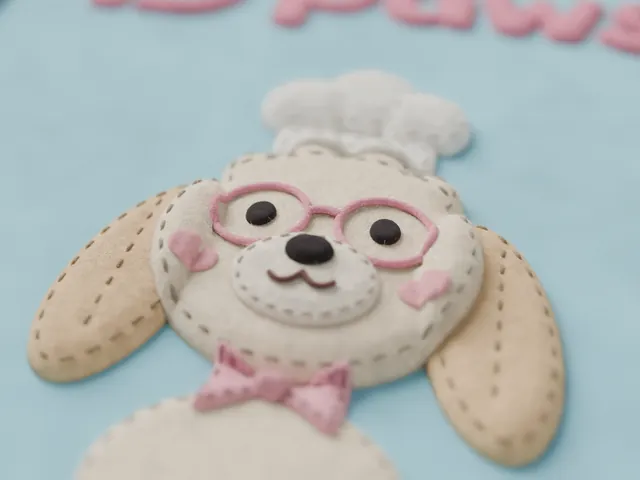
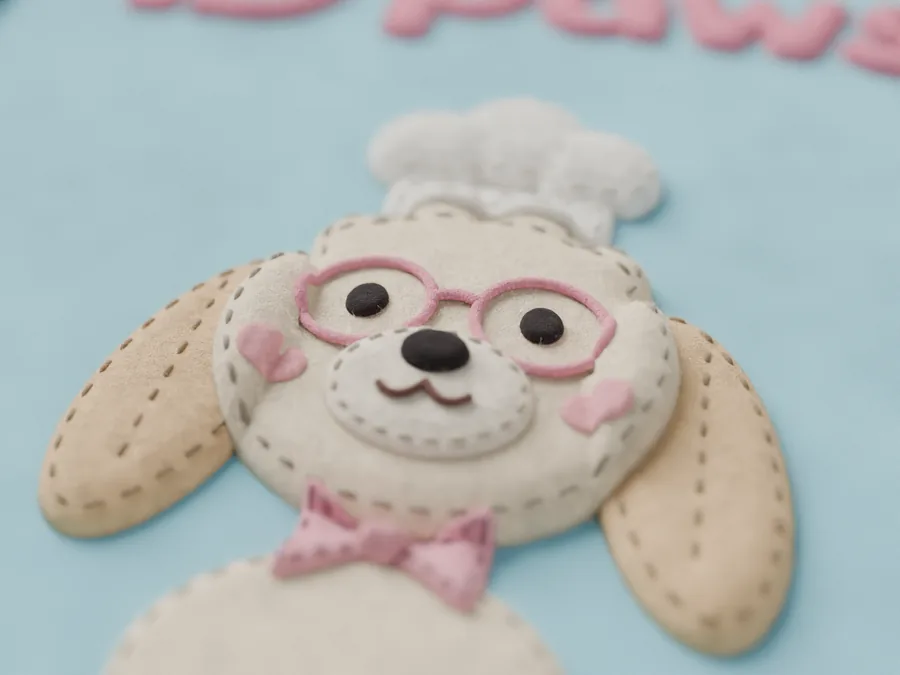
The full set: cover and three pages on a wooden tableCover: a felt dog in glasses and a chef’s hatClose-up: felt fuzz and rings of stitchingPage 1: cherry pockets with lids that hide treatsPages 2–3: cherry hair clips and a three-tier cake
How I made it
Modelling: Built the cover, three pages, spine and binding in Blender together with AI. Every flap, pocket and small part is its own object, so each can be lifted or swapped on its own.
Materials: Three families: felt, velvet and thread. The felt has a layer of fine fuzz, and each piece is edged with a ring of dashed stitches, so it reads like a real handmade book.
Rendering: Rendered in Cycles with a window light and a fill light, shot on a wooden table like a product photo.
On the web: Exported as a web 3D model (Three.js) you can rotate and zoom. Tap a flap and it curls up like real fabric to show the treats underneath; you can also swap parts with one tap.
As an outside marketing consultant, I advised the management of London agency 2050.London: as AI makes content ever cheaper to produce, how can an agency stay distinctive?
£35.5bnUK ad spend in 2024, a record high
94%UK brand marketers already using AI in digital advertising
How I did it
Used PESTLE for the UK advertising market and STP and client portfolio analysis for 2050.London’s positioning, then assessed its brand and marketing mix.
Findings and recommendations
AI is now mainstream, so agencies’ old promise of speed and capacity is being levelled out.
What AI can’t replace is strategic insight, creativity and orchestrating integrated campaigns. AI should be positioned as a support tool, not the selling point itself.
Advertisers are shifting budgets to paid search, paid social and influencer marketing.
Recommended sharper brand differentiation and a UK–US partner network.
BS5205 Sustainable and Responsible Management2026.04 · Team 33 · individual impact report
Sustain The Pump: a regenerative campus gym
Our team designed a regenerative campus gym: a space that uses energy but also gives resources back.
My part
The “health” and “wellbeing” layers of the living systems map, connecting students to campus green space. My teammates had focused on energy and material flows, so this angle surprised them a little.
The zero-plastic membership model, measured by energy generated (kWh), plastic bottles saved and weekly participation.
Vision
1–2 years: launch the zero-plastic membership and pilot the first living plant wall.
5–10 years: living walls, rainwater harvesting and kinetic energy recovery turn the gym from a resource consumer into a net contributor, in line with UN Sustainable Development Goal 11.
What I learned
Growing up in China, most of the sustainability messaging I saw was top-down, about compliance and marketing, so I used to see sustainability as an add-on to a traditional business model. This module’s living systems perspective changed that.
I also found that the most valuable contribution in collaborative design is often not answering the existing question, but redefining it.